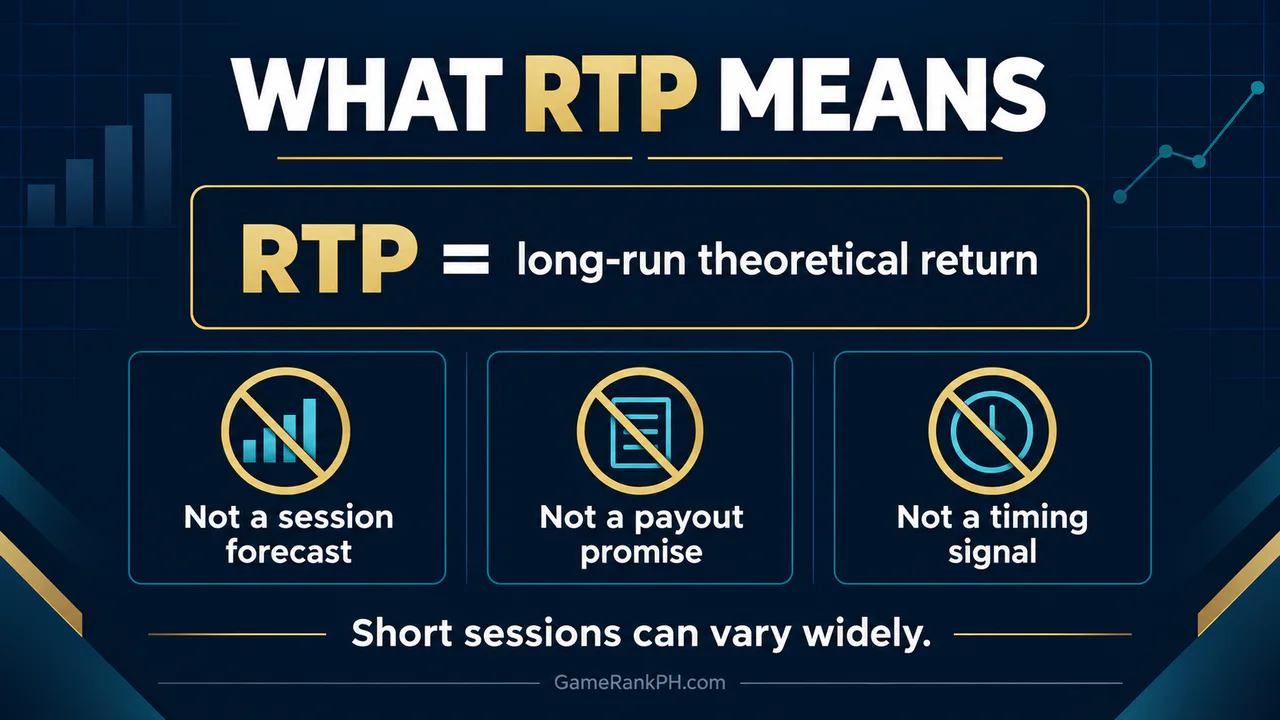
RTP means return to player. In a slot specification, it is a long-run theoretical percentage calculated across a very large number of game events under defined rules. It is not a forecast for your next spin, tonight’s session or a specific deposit.
A 96% RTP does not mean every ₱100 session returns ₱96. Short results can be far above or below the theoretical figure, and the remaining percentage is not a fee collected evenly from each player.
Editorial method: GameRankPH reviewed current official regulator and public-agency sources, separated verified facts from practical advice, and did not use affiliate claims as evidence. Reviewed by the GameRankPH Editorial Review desk on 15 September 2026.
RTP in one formula
If a game has a theoretical RTP of 96%, the corresponding theoretical house edge is 4%: 100% minus 96%. These figures describe the model over the long run. They do not remove randomness or guarantee that an individual player receives a particular amount back.
| Term | What it describes | What it cannot tell you |
|---|---|---|
| RTP | Long-run theoretical return | Your next result |
| House edge | Long-run theoretical operator advantage | Exact session loss |
| Volatility | How uneven results may feel | A guaranteed bankroll need |
| Hit frequency | How often some win may occur | Whether the win exceeds the bet |
Why a short session can look nothing like RTP
Random outcomes do not owe a player a correction after a losing run. Ten spins, one hundred spins or even a much longer personal session may not resemble the published theoretical percentage. RTP becomes meaningful as a specification and comparison input, not as a promise.
RTP and volatility are different
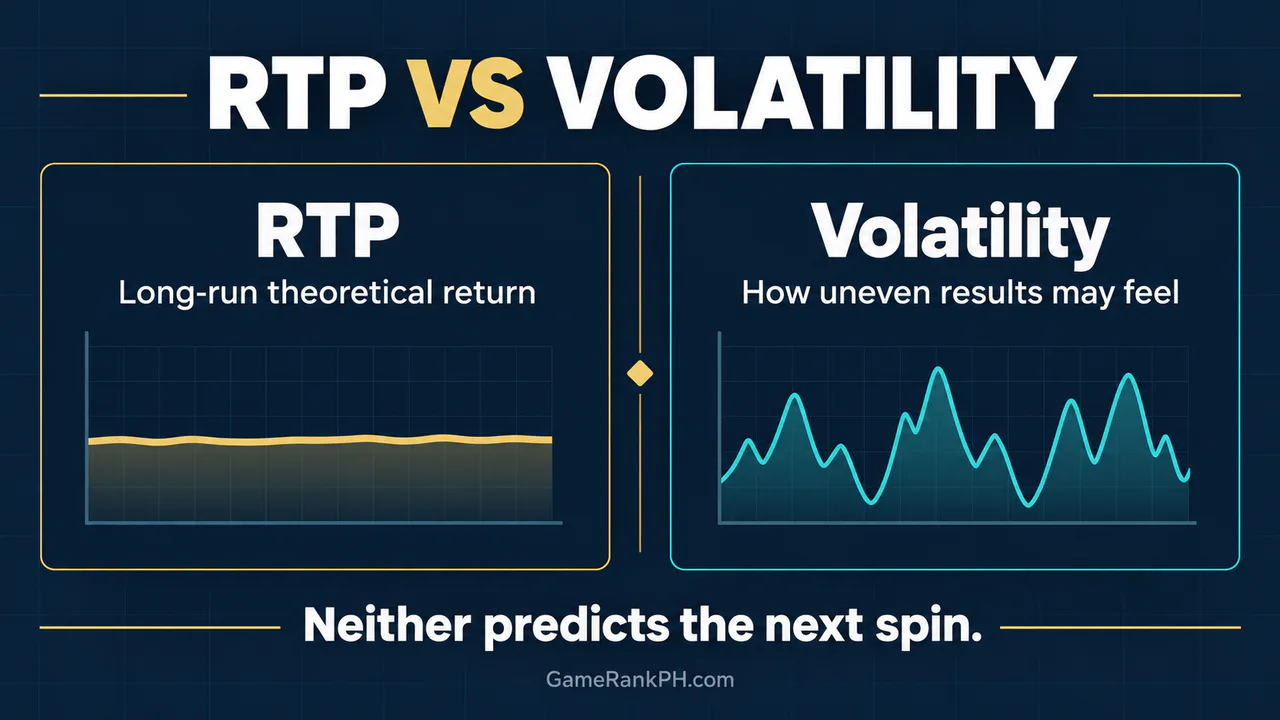
Two slots can show the same RTP while distributing outcomes differently. A higher-volatility game may concentrate more of its theoretical return in less frequent outcomes; a lower-volatility game may produce more frequent but smaller changes. Neither pattern predicts the next spin.
| Player question | Relevant concept | Limit |
|---|---|---|
| How much is theoretically returned long term? | RTP | Not personal forecast |
| How uneven might results feel? | Volatility | Labels may differ by provider |
| How often does any payout appear? | Hit frequency | A payout can be below the stake |
Where to verify a game figure
Use the in-game information screen, paytable or official provider documentation available through the verified platform. Record the exact game title and version because configurations can differ. The PAGCOR game-approval guide explains why provider, title and platform checks are separate. A general PT game profile or JILI game search result should not be used to infer the RTP of every title.
Common RTP myths
- “The game is due after many losses.” Random events do not create a debt to the player.
- “Changing the bet unlocks a better cycle.” Do not assume a timing pattern without documented game rules.
- “High RTP means low risk.” Volatility and session length still matter.
- “A streamer’s result proves the payout.” One session is not statistical evidence.
A safer way to use RTP information
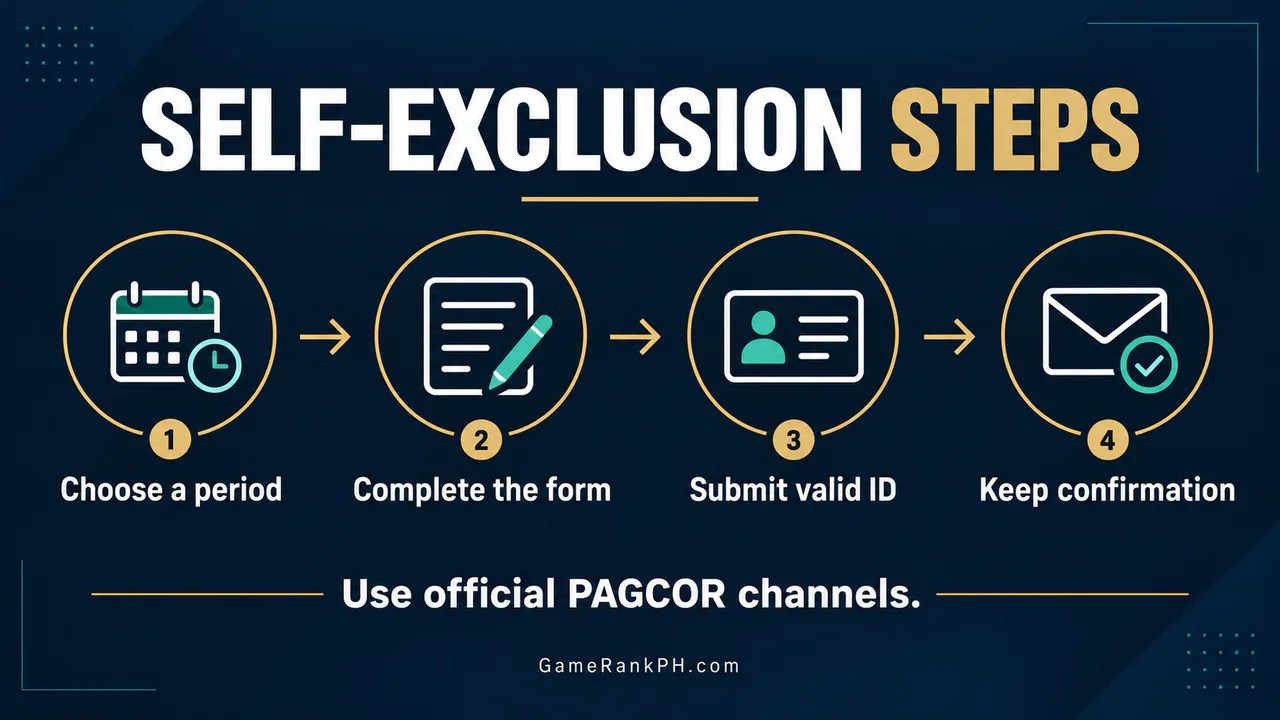
Use RTP as one comparison factor after confirming the platform and game information. Set a fixed entertainment budget, do not borrow, and stop at the planned limit. If play is no longer voluntary or losses are being chased, review the PAGCOR self-exclusion guide instead of looking for a “recovery” strategy.
Sources and update note
Updated 15 September 2026 from current regulatory and public gambling-information sources. Game specifications can change by title, version and market, so verify inside the exact game. Educational only; no strategy can guarantee a win. Adults 21+ only.
Official sources
- PAGCOR Electronic Gaming Licensing Department
- UK Gambling Commission RTP guide
- PAGCOR regulatory portal
Related reading on GameRankPH
Responsible-use note: Online gambling involves financial risk. Never borrow to play, never chase losses, and stop if play is affecting your finances, work, sleep or relationships. GameRankPH does not guarantee winnings, withdrawals, licensing continuity or dispute outcomes.